


The Complete Guide to Long-Acting Injectable (LAI) Formulations
Table of Contents
A long-acting injectable program almost never fails because the team picked the wrong release mechanism. It fails at the seams: the handoff between particle engineering and aseptic fill, the in vitro release method nobody started early enough, the analytical package that cannot explain a batch to a reviewer. The platform decision that teams agonize over matters far less than whether particle sizing, sterile manufacturing, and a discriminating release method sit under one quality system, and the single most underestimated item on the critical path is the release method, not the formulation.
That claim runs against how most LAI guides are written. They open with a platform tour, hand you a comparison table, and imply the hard part is choosing between microspheres and a depot. The chemistry of each platform is well understood. What separates a program that reaches commercial supply from one that burns two years and a funding round is whether the disciplines that surround the formulation were built in parallel with it. This piece makes that case, names the mechanisms underneath it, and gives you the numbers to defend the decisions with your own team.
The demand is real, which is exactly why sloppy programs get expensive
Long-acting injectable therapeutics were worth about $18.3 billion in 2025, and the sell-side consensus puts growth near 12.8% a year through 2033, with North America holding roughly 42% of the market and central nervous system indications leading. The demand pull is genuine, and it is pulling molecules into LAI formats faster than most sponsors build the analytical and manufacturing discipline to support them.
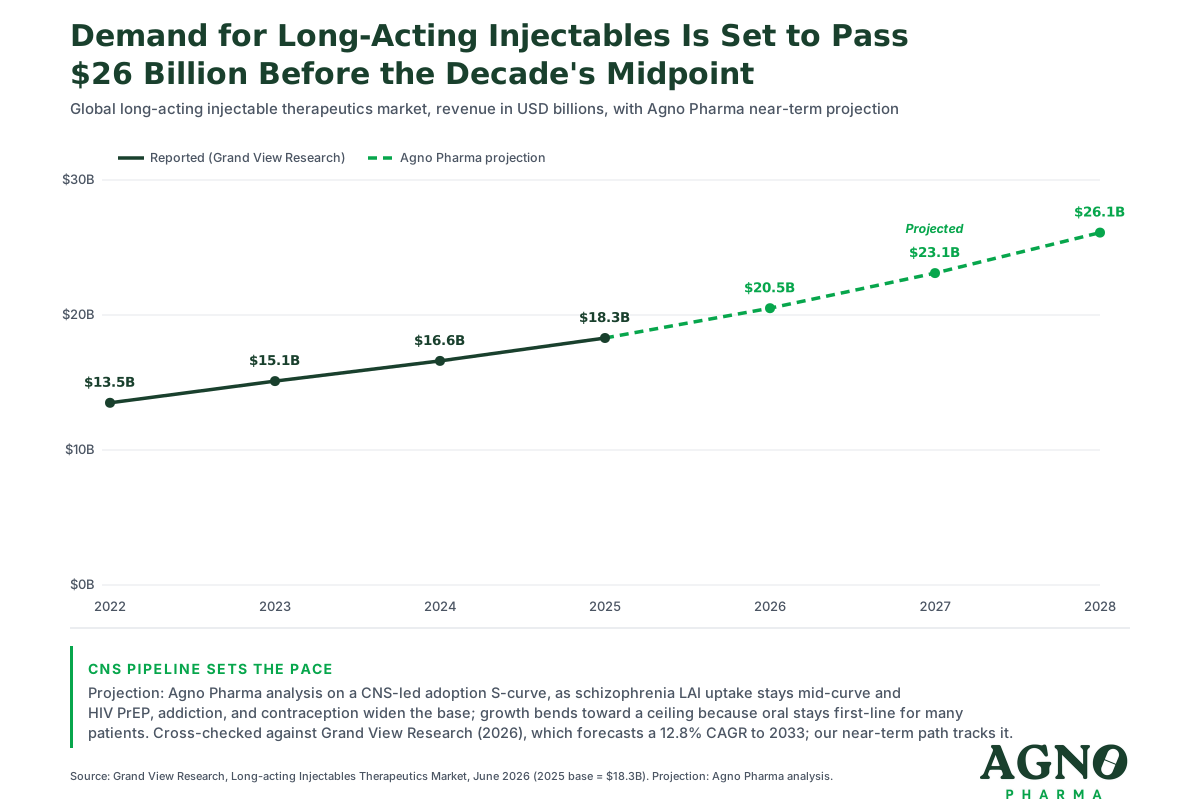
The commercial logic is simple. A molecule that reaches the market as a monthly or quarterly injection changes its own adherence profile, its payer conversation, and its competitive position. That prize is why programs get pushed toward LAI formats early, sometimes before the molecule’s physicochemical behavior has earned the decision. The cost of that haste does not show up at feasibility. It shows up at the clinical batch that will not release, or the tech transfer that adds a quarter, when the money and the timeline are least forgiving.
Quote the clinical case honestly, or a reviewer will do it for you
The evidence that LAIs improve outcomes is real, and it is also routinely overstated in pitch decks. The largest systematic review of long-acting versus oral antipsychotics in schizophrenia, published in The Lancet Psychiatry in 2021, pooled 101 studies and found LAIs lowered the risk of hospitalisation or relapse across every study design. The size of that benefit, though, depends heavily on how the study was run.
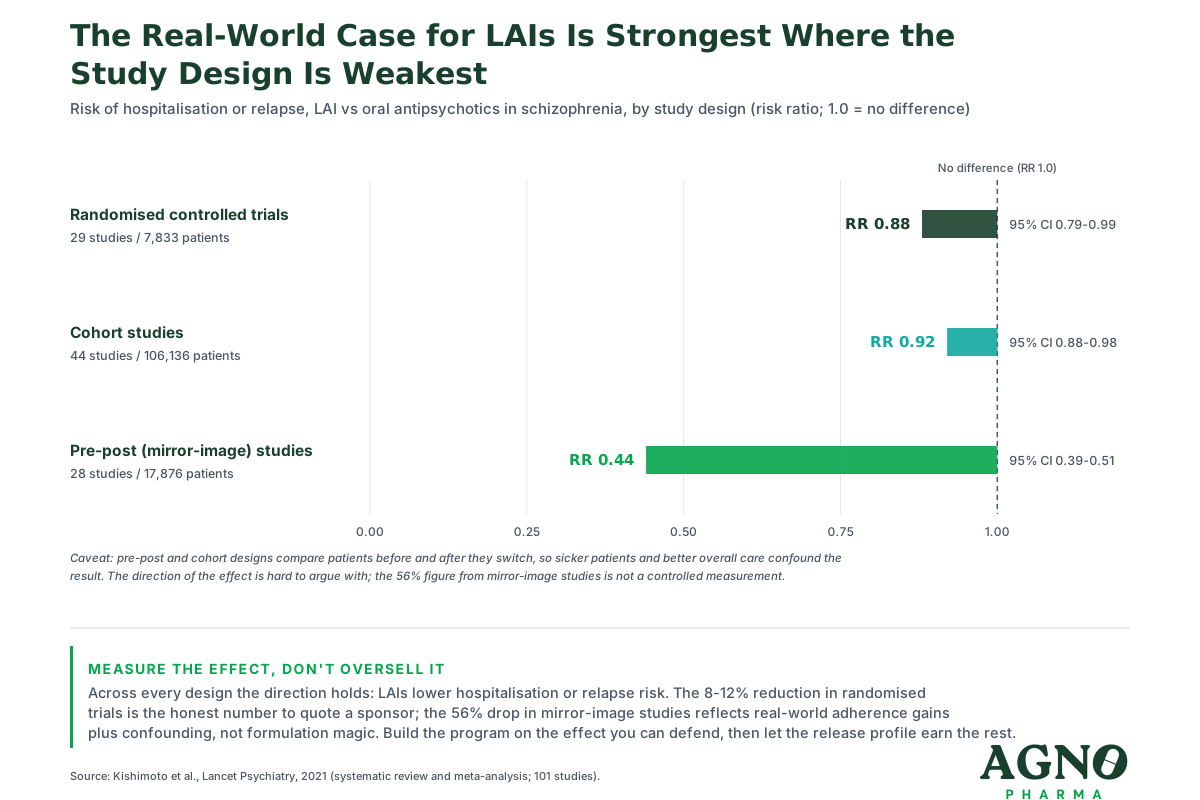
In randomised controlled trials, the reduction in hospitalisation or relapse risk was 8% to 12% (RR 0.88, 95% CI 0.79 to 0.99). In real-world mirror-image studies that compare the same patients before and after switching, the apparent reduction jumped to 56% (RR 0.44). That larger number is not formulation magic. It reflects real adherence gains plus the fact that sicker patients get switched and their care improves at the same time. The 8% to 12% figure is the one to put in front of a sponsor, because it is the one a payer or a regulator can defend. The clinical value that does hold up comes from a release profile that stays inside the therapeutic window for the entire dosing interval, and that is a chemistry-and-analytics problem long before it is a marketing one.
We tell clients to build the business case on the randomised-trial number and treat the mirror-image data as supporting color, not the headline. If your value story needs the 56% to work, the program has a pricing problem, not a formulation problem, and a burst-release excursion in month one will undo the adherence argument you were counting on anyway.
The Technical Team at Agno Pharma
Pick a platform, then stop pretending the choice is where programs are won
Every LAI is built on one of a handful of release mechanisms, and no platform is universally best. The right choice follows from the molecule’s solubility and lipophilicity, the target duration, the patient population, and the route. That decision deserves real feasibility work. It does not deserve the outsized share of program anxiety it usually gets, because the platforms have all been reduced to practice in approved products. The differentiator is execution across formulation, sterile processing, and analytics, which is where complex formulation development earns its keep or exposes its gaps.
| Platform | Release mechanism | Typical duration | Where the difficulty actually sits |
|---|---|---|---|
| Biodegradable PLGA microspheres | Polymer hydrolysis and erosion | 2 weeks to 6 months | Burst control, particle size distribution, residual solvents |
| In situ forming depots (ISFD) | Phase inversion on injection | 1 to 6 months | Depot formation kinetics, the vial-to-tissue gap, injection viscosity |
| Oil-based depots | Partitioning and diffusion from a lipid vehicle | Days to weeks | Drug lipophilicity, prodrug ester stability, syringeability |
| Aqueous micro / nano suspensions | Dissolution of suspended particles at the site | Days to months | Particle size control, suspension stability, resuspendability |
| Implants and subdermal systems | Diffusion or erosion through a polymer matrix | Months to years | Fabrication precision, drug loading, biocompatibility |
A molecule with poor aqueous solubility and moderate lipophilicity can be a candidate for three of these systems at once. The feasibility question is not which platform is most sophisticated. It is which one produces the target release profile with a manufacturing process you can actually validate and an analytical method you can actually run at release. Answer that before you commit development spend, not after.
PLGA microspheres: the chemistry that decides reproducibility
PLGA microspheres give you tunable release, and they make you earn it. By adjusting polymer molecular weight, the lactide-to-glycolide ratio, microsphere size, and drug loading, you can target durations from two weeks to six months. The mechanism is hydrolysis plus erosion: water penetrates the matrix, cleaves ester bonds, drops the molecular weight, and the polymer erodes as drug releases. The problem that defines the platform is burst release, the rapid early release that spikes plasma concentration and can push a sensitive population out of tolerability in the first days.
The lever that governs batch-to-batch reproducibility is particle size distribution. Emulsification conditions, solvent extraction dynamics, hardening, and drying all move particle morphology and size, and size drives in vitro and in vivo release directly. A small shift in shear or extraction rate at scale can produce a measurable change in the release curve, which is why laboratory success does not predict a clean pilot batch. Map the critical material attributes and critical process parameters early with a structured quality by design approach, and you build a design space that survives the NDA. Skip it, and you spend the review cycle explaining variability you never characterized.
With PLGA microspheres the QbD work you did at 5 grams is what saves you at the pre-approval inspection. When a reviewer asks why batch 14 released faster than batch 3, you either open a documented design space that already answers it, or you open an investigation. We have watched both happen. The first costs a meeting; the second costs a quarter.
The Technical Team at Agno Pharma
Oil depots and aqueous suspensions: the simpler paths, when the molecule earns them
Not every program needs a polymer. Oil-based depots dissolve or suspend the drug in a lipid vehicle, and release is set by how the drug partitions between the oil and surrounding tissue fluid. For lipophilic molecules or prodrug esters with high oil affinity, this sustains release for days to weeks. Testosterone undecanoate and haloperidol decanoate are the familiar commercial examples, both using a prodrug ester to extend depot residence and give a predictable pharmacokinetic profile. The formulation work is real, but it is a shorter path than microspheres for the right molecule, and choosing the polymer system anyway is the kind of gold-plating that burns a preclinical budget on controls the molecule may never need.
Aqueous micro and nano suspensions serve low-solubility drugs through controlled dissolution at the injection site. Smaller particles dissolve faster, so particle size is the primary lever on release rate and duration. Producing these at clinical and commercial scale relies on particle size reduction under aseptic conditions, and on suspension behavior you have characterized before scale-up: physical stability against agglomeration, and clean resuspension after settling. Nano-sized particles can also distribute differently than microsuspensions, with lymphatic uptake becoming a factor in the PK model for some routes.
- Lipophilicity (logP) points the way: high logP favors an oil depot, low logP favors a suspension where particle engineering sets the rate.
- Duration separates them: oil depots run days to a few weeks; nanosuspensions can reach months with the right stabilization strategy.
- Prodrug suitability can extend an oil depot, but confirm ester stability under manufacturing and storage before you build the plan around it.
- Injection site tolerability can sink an oil depot in some populations; evaluate it in preclinical work before locking the route.
In situ forming depots: easy to make, hard to predict
ISFD systems inject as a low-viscosity liquid that solidifies into a controlled-release matrix at the site. The common mechanism is phase inversion: drug and a biodegradable polymer such as PLGA dissolve in a water-miscible solvent, usually N-methyl-2-pyrrolidone. On contact with tissue, the solvent diffuses out, the polymer precipitates, and a depot forms that releases over weeks to months. The manufacturing appeal is genuine, since there is no emulsification or spray drying, and the product can be filled as a liquid into a prefilled syringe and given without reconstitution.
The difficulty moves to depot formation kinetics. How fast the solvent exchanges and the polymer precipitates sets the burst profile and the depot morphology. Push phase inversion too fast and you form a dense outer skin that traps solvent and shifts release away from what your in vitro model predicted. That vial-to-tissue disconnect is the thing that must be characterized preclinically, in depot morphology and in vivo release, not discovered in the clinic. The liquid also has to stay stable on the shelf, with no polymer precipitation, viscosity drift, or degradation across the intended storage window.
The in vitro release method is the pacing item, not the formulation
Here is the position most LAI guides will not commit to: the hardest deliverable in a long-acting injectable program is usually not the formulation, it is the in vitro release method you have to invent to prove the formulation works. There is no compendial dissolution method for a microsphere, a depot, or a nanosuspension. You build one, and it has to be discriminating enough to catch a batch that will misbehave in a patient and predictive enough to correlate with in vivo release over weeks or months. Teams treat this as a late analytical chore. It is the critical path.
A program that starts in vitro release testing late finds out at the worst moment that its method cannot release clinical batches or cannot support an accelerated-stability read, and the fix is not a tweak, it is a method redevelopment that stalls the filing. Get analytical method development and validation moving in parallel with formulation, and give it the same seniority. The method is not there to check the formulation’s work. For an LAI, the method is half the product.
We have seen more LAI timelines slip on the release method than on the formulation. A team nails the microsphere, then spends nine months building a dialysis or flow-through method that actually discriminates and correlates, all of it on the critical path because it was started after the formulation was locked. Start the method the day you pick the platform. It is slower to build than people think, and everything downstream waits on it.
The Technical Team at Agno Pharma
The same discipline extends to stability. ICH stability testing for an LAI has to account for the degradation pathways of biodegradable polymers, particle morphology drift during storage, and container-closure compatibility across the full shelf life, and it has to start early enough to support the clinical filing. A stability program bolted on late is a program that discovers its problems after the batches are made.
Programs slip at the tech transfer, not the bench
Integration beats handoffs, and the most dangerous moment in a molecule’s life is a tech transfer between vendors. That is house doctrine at Agno, and LAIs are where it bites hardest, because an LAI is not one deliverable. It is particle engineering, sterile drug product, and a purpose-built analytical package, and every seam between those disciplines is a place where a timeline slips, an impurity hides, or accountability gets lost. When the API house, the fill-finish site, and the analytical lab belong to three different quality systems, the receiving site often has to redevelop the release method, and that alone can add weeks to months.
Every LAI is a sterile parenteral, so sterile injectable manufacturing has to run under aseptic conditions at every step: aseptic emulsification and drying for microspheres, aseptic particle size reduction for suspensions, aseptic filling for depots. Scale-up then surfaces variables the bench never showed, since droplet size, shear distribution in a larger vessel, and drying uniformity all move as batch size grows. Specific-energy and shear-rate principles translate milling and homogenization from bench to pilot to commercial while holding the critical quality attributes, but only inside aseptic manufacturing that was designed for the product, not retrofitted to it. And the transition from clinical to commercial supply lives or dies on a documented technology transfer package, the kind covered in our guidance on bridging clinical and commercial manufacturing. Without it, scale-up is not a controlled transition, it is a redevelopment.
We built Agno as a single quality system across API, drug product, and analytics on purpose, because we kept seeing the same failure: two capable vendors, one broken seam between them, and a sponsor absorbing the cost. For a long-acting injectable, keeping particle engineering, aseptic fill, and the release method under one roof is not a convenience. It is how you keep the interfaces from becoming the reason the program is late.
James Chen, PhD, Chief Executive Officer, Agno Pharma (quote pending executive sign-off before publication)
Outsourced sterile work is climbing, so read the market honestly
The demand for LAIs feeds a larger shift: sponsors keep routing complex sterile work to specialists rather than building and qualifying capacity they will use for one program. The sterile injectable contract manufacturing market sat near $24.5 billion in 2025 and is reported around $26.9 billion for 2026, on a low-double-digit growth path.
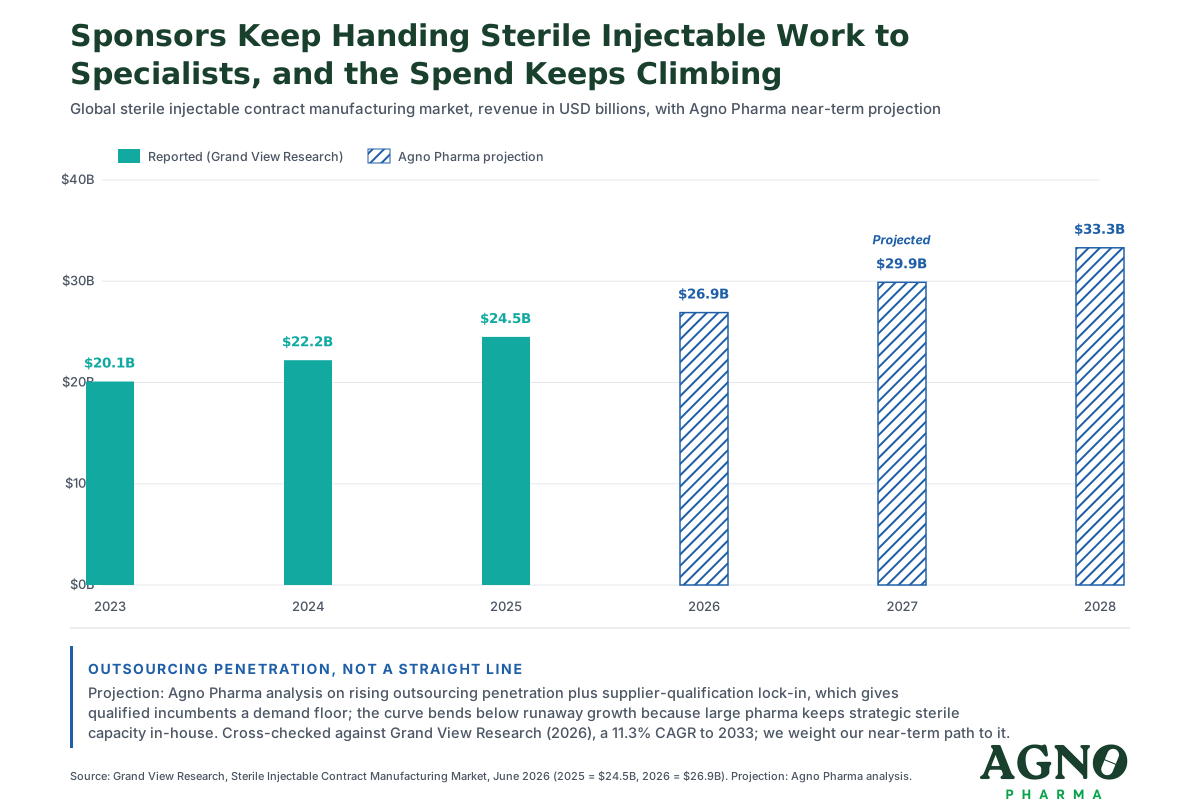
Two structural forces set that trajectory. Outsourcing penetration rises because the capacity and expertise for complex sterile work are hard to justify in-house for a single molecule. And once a sterile supplier is qualified, sponsors rarely move it, because the switching cost and requalification risk are high, which gives a qualified incumbent a demand floor. The same lock-in caps how fast share reshuffles, and large pharma keeps strategic sterile capacity in-house, so the curve bends rather than compounding without limit.
One market, six numbers: buy the capability, not the headline stat
Before that market figure goes into your board deck, notice that the same market is reported anywhere from $4.7 billion to $37.8 billion depending on who is counting.
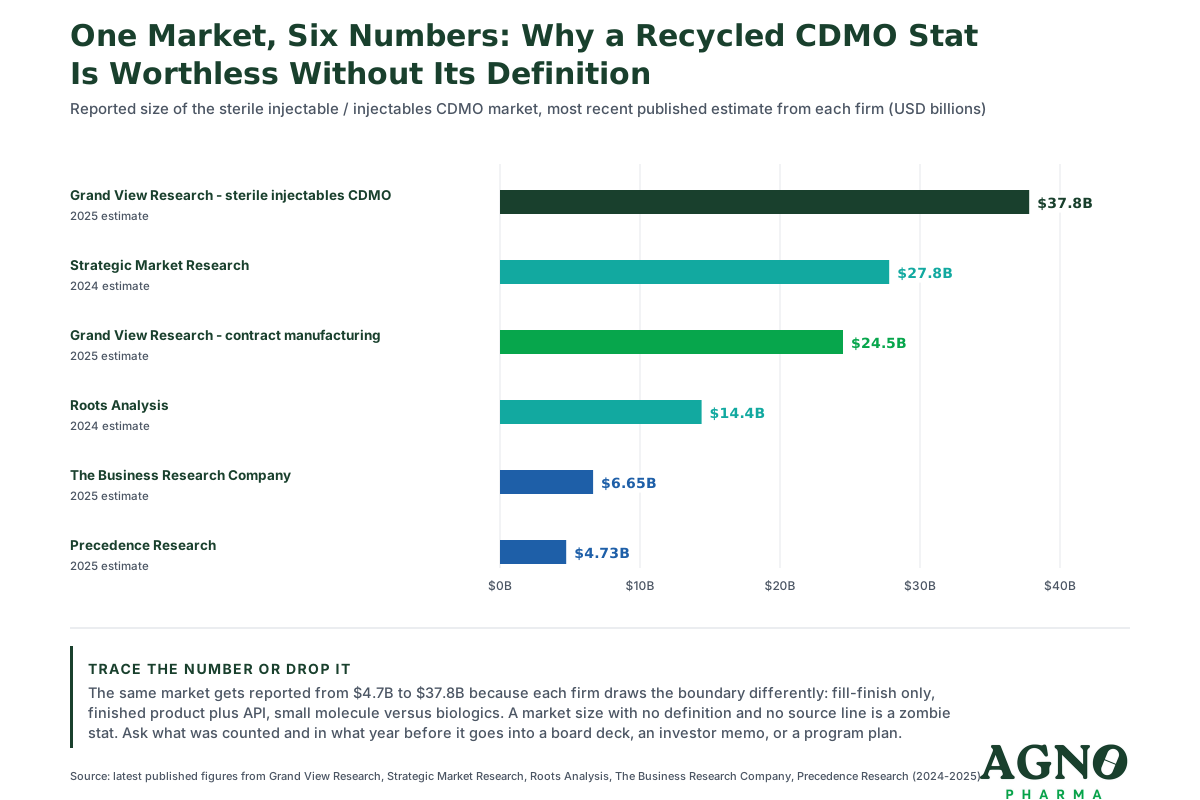
An eight-fold spread is not a data error. It is a definitions problem, and it is the single most common way a recycled market number ends up meaningless. Some firms count fill-finish services only, some count finished product plus API, some count small molecule and some count biologics. A market size with no scope and no source line is a zombie stat, and it travels through a dozen CDMO blogs precisely because nobody checked what it measured. Ask what was counted and in what year before it anchors an investment case.
The same discipline applies to picking the partner. Square footage, reactor volume, and a new-facility press release are vanity metrics. The scoreboard that matters is batches released right the first time, inspections passed, and programs that clear review, and a low unit price that yields an out-of-spec batch cost the sponsor its timeline, not its budget line. When you are choosing a CDMO for an LAI, weigh the capability to run the release method, hold the particle size, and pass the sterility audit far above the quoted price per batch. The cheap program that requalifies twice is the expensive one.
How the Particle Sciences team at Agno approaches end-to-end LAI development
Agno developed and scaled LAIs across the platforms that matter: PLGA microsphere depots for peptides and small molecules, in situ forming depots with controlled solidification, and aqueous microsuspensions for CNS candidates with tight particle size control. Across those programs, the pattern that predicts success is not the platform. It is whether particle engineering, aseptic manufacturing, and the analytical package were built together, under one quality system, from feasibility onward. A long-acting injectable CDMO that runs those disciplines as separate services rebuilds the seams the science was supposed to avoid.
Documented programs from the Particle Sciences team bear this out. In one PLGA microsphere depot for a peptide, the work that controlled burst release, residual solvents, and reproducible particle size was a structured QbD exercise that mapped polymer grade, molecular weight, solvent system, shear, coacervation, and drying to the release profile, then held those attributes through aseptic scale-up. In an ISFD program, the effort went into solidification kinetics and injection consistency so the depot formed reproducibly at scale. In a set of CNS aqueous suspensions, the team built stability-indicating methods for assay, impurities, viscosity, particle size, and syringeability, then carried lab-scale processes to pilot and commercial-ready scale on specific-energy and shear-rate principles while holding the critical quality attributes and preparing the technology transfer package. Different platforms, one throughline: the interfaces were managed, so the interfaces did not become the delay.
The stance this article opened with is the same one Agno operates on. LAI programs stall at the seams, not the science, and the release method is the pacing item teams underestimate. Build for the interfaces, start the analytical work the day you pick the platform, and the platform decision becomes what it should have been all along: an early, well-reasoned choice, not the thing your program lives or dies on.