Guide to the Modern CDMO: A Strategic Blueprint for Pharmaceutical Leaders
Table of Contents
With the global CDMO market estimated at approximately $220 billion in 2025 and projected to exceed $380 billion by 2033, these specialized partners have become indispensable for both emerging biotechnology companies and established pharmaceutical manufacturers seeking to accelerate drug development timelines while managing costs and regulatory complexity.
This comprehensive guide provides pharmaceutical leaders with the strategic framework needed to understand, evaluate, and partner with CDMOs effectively. From understanding the fundamental differences between contract service models to mastering technology transfer processes and establishing governance structures, this blueprint addresses every critical aspect of CDMO engagement.
Understanding the Modern CDMO
A Contract Development and Manufacturing Organization is a specialized company that provides comprehensive pharmaceutical development and manufacturing services to drug companies on a contract basis. Unlike their predecessors, modern CDMOs serve as strategic partners throughout the entire drug development lifecycle, from early-stage formulation development through commercial manufacturing and beyond.
The Evolution from CMO to CDMO
What began as simple “factory-for-hire” arrangements in the 1990s has evolved into sophisticated, integrated partnerships. The traditional Contract Manufacturing Organization (CMO) focused primarily on production capacity, offering manufacturing services for products with already-established processes. Pharmaceutical companies would develop their products internally, then transfer completed processes to CMOs for production.
The CDMO model represents a fundamental shift in this relationship. By combining development capabilities with manufacturing services, CDMOs offer integrated solutions spanning the complete product lifecycle. This evolution reflects several industry dynamics: the increasing complexity of therapeutic modalities, the rising costs of maintaining specialized manufacturing infrastructure, and the strategic advantage of accessing external expertise for challenging molecules.
Distinguishing CDMOs, CMOs, and CROs
Understanding the distinctions between pharmaceutical service providers is crucial for selecting the right partner. A Contract Research Organization (CRO) focuses on clinical research services, managing clinical trials, regulatory submissions, pharmacovigilance, and data management. CROs work on the clinical validation of drug candidates but typically do not develop or manufacture products.
A CMO provides manufacturing capacity for products with established processes. The CMO receives a completed technology package and focuses on efficient production, offering competitive pricing, regulatory compliance, flexibility in production capability, and on-time delivery. The relationship is often transactional, centered on specific manufacturing campaigns.
The CDMO combines both development and manufacturing under one organizational umbrella. This integration enables end-to-end support from initial process development through scale-up, clinical trial material production, process validation, and commercial manufacturing. This model eliminates the technology transfer risks and timeline delays associated with moving projects between different service providers.
Service Provider
Primary Focus
Core Services
Typical Engagement
CRO
Clinical Research
Clinical trials, regulatory submissions, pharmacovigilance, data management
Drug validation and approval pathway
CMO
Manufacturing Capacity
Production of established products, packaging, distribution
Transactional manufacturing campaigns
CDMO
Integrated Development + Manufacturing
Formulation, process development, scale-up, clinical & commercial manufacturing
End-to-end partnership from development through commercialization
The Strategic Case for CDMO Partnership
The decision to engage a CDMO partner extends far beyond simple cost considerations. For pharmaceutical leaders, understanding the strategic drivers behind outsourcing decisions shapes how partnerships are structured and managed.
Capital Efficiency and Risk Mitigation
Building and maintaining specialized pharmaceutical manufacturing infrastructure requires substantial capital investment. Biopharmaceutical production facilities can cost hundreds of millions of dollars, with specialized capabilities like cell and gene therapy manufacturing requiring even greater investment.
Historically, pharmaceutical companies built dedicated manufacturing capacity for drugs still in development, only to see those facilities underutilized if products failed in Phase III clinical trials. Working with a CDMO limits this financial risk by converting fixed capital costs into variable expenses aligned with actual product success.
Access to Specialized Expertise
Some CDMOs concentrate expertise in manufacturing challenging products and formulations that individual pharmaceutical companies may lack internally.
This specialization becomes particularly valuable for complex modalities including:
Contracting with a specialized CDMO often provides a faster and less costly path than building new internal capabilities.
Accelerated Development Timelines
Time-to-market represents a critical competitive factor in pharmaceutical development. CDMOs with established infrastructure, qualified personnel, and validated processes can significantly compress development timelines. Industry case studies show experienced CDMOs can advance small molecule programs to Investigational New Drug (IND) submission in approximately 11 months, compared to the multi-year timelines often seen in traditional development. This acceleration directly translates to extended patent protection periods and earlier market entry.
Scalability and Flexibility
CDMOs offer the ability to adjust production volumes to meet changing demands across different phases of drug development. This scalability proves particularly beneficial during transitions from clinical to commercial manufacturing, when demand predictions carry significant uncertainty. Rather than building fixed capacity for peak projected demand, sponsors can leverage CDMO flexibility to right-size production as market conditions become clearer.
Understanding CDMO Capabilities and Services
Modern CDMOs offer diverse service portfolios spanning multiple therapeutic modalities and development stages. Understanding these capabilities enables pharmaceutical leaders to match organizational needs with appropriate partners.
The biologics segment represents the fastest-growing area of CDMO services. Manufacturing monoclonal antibodies, recombinant proteins, vaccines, and biosimilars requires specialized infrastructure including mammalian and microbial fermentation systems, purification trains, and aseptic fill/finish capabilities. CDMOs invest heavily in single-use bioreactor systems, continuous bioprocessing technologies, and sophisticated cold chain logistics to support temperature-sensitive biologics.
Cell and Gene Therapy Services
Cell and gene therapy manufacturing represents a specialized CDMO capability requiring distinct infrastructure and expertise. Services include viral vector production for adeno-associated virus (AAV), lentivirus, and adenovirus platforms. Cell therapy manufacturing encompasses both autologous processes where patient-specific cells are modified and returned, and allogeneic approaches using donor-derived cell lines. Plasmid DNA manufacturing supports gene therapy vector production and mRNA vaccine development. CDMOs serving this market maintain cleanroom suites designed for personalized medicine production alongside larger-scale manufacturing capabilities.
Specialized Capabilities
Beyond core manufacturing, CDMOs differentiate through specialized capabilities including high-potency API handling with appropriate containment engineering, controlled substance manufacturing with DEA registration and security infrastructure, sterile manufacturing for injectable products, and specialized delivery systems such as prefilled syringes and autoinjectors. Some CDMOs offer regulatory affairs support including CMC documentation, submission preparation, and global registration assistance.
The CDMO Selection Process: A Strategic Framework
Selecting the right CDMO partner represents one of the most consequential decisions a pharmaceutical company makes. The choice profoundly impacts drug development timelines, regulatory success, financial outcomes, and ultimately patient access to therapies. A structured, disciplined approach transforms vendor selection into strategic partnership formation.
Defining Internal Requirements
Before approaching potential CDMOs, organizations must honestly assess their internal situation. Critical questions include: What development stage is the product currently at? What specialized technologies or capabilities does the project require? What is the organization’s capacity for ongoing project oversight and management? What level of partnership depth—transactional versus strategic—aligns with organizational goals? Brutal honesty about available internal resources and realistic timeline expectations prevents misaligned partnerships.
Establishing Selection Criteria
Well-defined selection criteria transform internal project requirements into objective, actionable benchmarks. Criteria development should involve cross-functional input from R&D, manufacturing, quality assurance, regulatory affairs, supply chain, and business leadership. Key domains typically include technical and process capability, regulatory compliance track record, quality systems maturity, operational capacity, financial stability, customer service history, support services breadth, and cultural fit.
Selection Domain
Key Evaluation Points
Technical Capability
Relevant platform experience (small molecule, drug implantable devices, biologics, cell/gene therapy); equipment compatibility; scale range from development through commercial; specialized technologies (high potency, sterile, controlled release, DEA controlled substances)
Regulatory Track Record
FDA, EMA, PMDA inspection history; warning letter or Form 483 observations; successful product approvals supported; global filing experience; CMC documentation quality
Quality Systems
Quality culture beyond compliance; deviation management maturity; CAPA effectiveness; change control robustness; supplier qualification programs; data integrity practices
Operational Capability
Available capacity and lead times; project management methodology; technology transfer track record; ability to scale from clinical to commercial volumes; supply chain management
Financial Stability
Financial strength and longevity; ownership structure; investment in capabilities; ability to sustain long-term programs; insurance and liability coverage
Cultural Fit
Communication style and responsiveness; flexibility and adaptability; partnership orientation versus transactional mindset; staff continuity and turnover rates; geographic and time zone alignment
The Request for Proposal Process
A detailed Request for Proposal (RFP) establishes the foundation for objective evaluation. The document should reflect project technical requirements, quality expectations, timeline constraints, and regulatory filing plans. Specific technology platforms required, batch sizes anticipated, and regulatory markets targeted should be clearly articulated. Well-designed RFPs enable suppliers to respond comprehensively and ensure responses can be scored on an even footing.
Due Diligence and Site Audits
Paper evaluations must be supplemented by rigorous due diligence. On-site audits verify that capabilities claimed in proposals exist in practice. During site visits, sponsors should meet the actual project team members who will work on their product, not just sales representatives. Assessment of quality culture requires observation of how employees at all levels interact with quality systems. Review of regulatory inspection history, including any FDA warning letters or observations, provides insight into compliance posture. Financial stability assessment ensures the partner can sustain operations throughout potentially lengthy development programs.
Weighted Scoring and Decision Making
Best practice employs a weighted scoring matrix where each criterion receives a weight reflecting its relative importance to the specific project. For tactical projects focused on immediate capacity needs, technical capability and cost may dominate weighting. For strategic alliances expected to span years of development and commercial supply, factors like long-term financial stability, supply chain resilience, and cultural compatibility become equally important. The decision matrix transforms subjective impressions into quantified comparisons supporting data-driven partner selection.
Mastering Technology Transfer
Technology transfer represents one of the highest-risk activities in pharmaceutical manufacturing. Industry research presented at CDMO Live 2025 revealed that approximately 50% of tech transfers experience quality problems, highlighting why effective transfer execution has become a critical CDMO differentiator. Understanding the process, potential pitfalls, and best practices enables sponsors to navigate this challenging phase successfully.
Understanding Technology Transfer
The ICH Q10 guidance defines technology transfer as the goal of transferring product and process knowledge between development and manufacturing, and within or between manufacturing sites, to achieve product realization. In practice, this means systematically moving scientific methods and manufacturing processes while ensuring product consistency, quality, and regulatory compliance. Completing a pharmaceutical tech transfer typically requires more than $5 million investment, a team of experts, and timelines ranging from 18 to 30 months. According to McKinsey research, external transfers to CDMOs add approximately 5.8 additional months compared to internal transfers.
Key Technology Transfer Phases
Successful transfers follow a structured process aligned with FDA process validation guidance. The first phase involves comprehensive process development documentation, including risk management according to ICH Q8(R2) pharmaceutical development guidelines. This establishes the foundation for control strategies and ongoing process improvement.
Process design captures knowledge gained through product development and scale-up activities, determining the manufacturing approach that will deliver consistent quality. Process performance qualification evaluates whether the designed process can achieve reproducible commercial manufacturing. The transfer concludes with continued process verification demonstrating ongoing control during routine production.
Critical Success Factors
Several factors distinguish successful technology transfers from problematic ones. Early planning initiated during product development allows adequate time to address issues before they become critical. Clear, transparent communication between all parties ensures alignment on objectives and expectations. Comprehensive risk identification with mitigation strategies prevents issues that could derail the transfer.
Analytical methods form the foundation of successful technology transfer and typically represent the first elements transferred. The results enable comparability assessments verifying that the receiving site produces an equivalent product. Understanding what analytical assays are capable of, and whether differences exist between test sites, ensures accurate interpretation of manufacturing data.
Equipment differences between sending and receiving sites often create challenges. Transferring processes between different brands and sizes of equipment introduces variability that must be characterized and controlled. Experienced CDMOs employ comprehensive methodologies for modeling and adapting equipment, mitigating risk through systematic validation of processing parameters on receiving site equipment.
Quality Systems and Regulatory Excellence
Of all factors considered when selecting a CDMO, demonstrated focus on quality stands as the most important. Manufacturing partners may offer speed, competitive pricing, or operational flexibility, but if final drug products fall short of commercial or regulatory quality standards, other considerations become irrelevant.
Understanding Quality Culture
Every CDMO publishes statements declaring commitment to quality, but website passages do not indicate genuine quality culture. True quality commitment embeds quality considerations in every decision, from equipment selection to hiring practices to process design choices. Proactive quality system improvements based on audits, process data analysis, equipment condition monitoring, and preventative maintenance efforts demonstrate commitment beyond mere compliance.
Due to the complexities of pharmaceutical manufacturing, occasional reactive responses to quality incidents occur even within well-run operations. The distinguishing factor is whether the organization treats such incidents as opportunities for systemic improvement or merely as problems to be resolved minimally. CDMOs with strong quality cultures investigate root causes thoroughly, implement robust corrective actions, and apply learnings across operations.
Regulatory Compliance Framework
CDMOs must maintain compliance with multiple regulatory frameworks depending on the markets they serve. FDA Current Good Manufacturing Practice (cGMP) requirements govern manufacturing for the US market. European operations must satisfy EMA requirements and EU GMP standards. Japanese market access requires compliance with PMDA expectations. CDMOs serving global markets must harmonize procedures satisfying multiple regulatory frameworks simultaneously.
The ICH Q10 pharmaceutical quality system model provides an international framework integrating ISO quality concepts with GMP requirements, complementing ICH Q8 pharmaceutical development and ICH Q9 quality risk management guidance. CDMOs with mature quality systems demonstrate alignment with this comprehensive model, not merely minimum regulatory compliance.
Sponsor Accountability
FDA guidance clarifies that outsourcing is inherently hiring a second party to perform operational processes that remain part of the manufacturer’s responsibilities. Even when a CDMO performs the chemistry and manufacturing, the sponsor owns the quality and must ensure compliance. This regulatory philosophy means that CDMO compliance failures directly impact sponsors through potential warning letters, product recalls, or approval delays. Robust quality agreements defining responsibilities, audit rights, and communication requirements form essential contractual foundations.
Partnership Governance and Performance Management
Selecting the right CDMO represents the beginning rather than the end of the partnership journey. Establishing robust governance structures and performance management systems ensures relationships deliver sustained value throughout multi-year programs.
Governance Structure Design
Effective governance structures establish clear communication channels, decision-making authorities, and escalation pathways. Joint steering committees comprising senior leaders from both organizations provide strategic oversight and address issues exceeding project team authority. Operational working teams manage day-to-day activities with defined meeting cadences and documentation requirements. Clear definition of roles and responsibilities prevents confusion about who owns specific decisions and actions.
Key Performance Indicators
A balanced set of Key Performance Indicators (KPIs) enables objective assessment of partnership health. Quality metrics might include batch success rates, deviation frequency, out-of-specification results, and audit findings. Timeline metrics track milestone adherence, cycle times, and responsiveness to requests. Cost metrics monitor budget variance and change order frequency. Relationship metrics assess communication effectiveness and issue resolution timeliness.
High-performing partnerships treat CDMO relationships as dynamic rather than static. Regular joint reviews, scorecards, and improvement incentives keep both parties aligned on targets like yield improvement, cycle time reduction, and defect elimination. Continuous improvement orientation transforms transactional relationships into genuine partnerships where both organizations benefit from enhanced performance.
Contract Structures
Contract terms should reflect the nature of the partnership and project requirements. Beyond standard terms covering pricing, intellectual property protection, and confidentiality, agreements should address capacity commitments, dual-sourcing flexibility, and supply chain resilience planning. Change control procedures must accommodate the inevitable adjustments arising during pharmaceutical development. Incorporating adaptability into agreements enables productive partnerships that evolve as projects progress from development through commercial manufacturing.
Market Trends and Future Outlook
The CDMO market continues evolving rapidly in response to scientific advances, regulatory changes, and industry dynamics. Understanding these trends enables pharmaceutical leaders to anticipate future needs and position their organizations advantageously.
Digital Transformation
The digital maturity gap between CDMOs has become a defining competitive differentiator. A MasterControl industry survey found that approximately 60% of CDMOs still operate at preliminary digital maturity levels, even as 92% of sponsors now raise digital expectations during RFP evaluations. Electronic batch records, real-time analytics, digital twin simulations, and cloud-based visibility have transitioned from optional enhancements to baseline expectations. Digitally mature CDMOs experience fewer documentation deviations and faster batch release cycles, directly benefiting sponsor timelines.
Advanced Therapy Expansion
The explosion of therapeutic modalities from small molecules and biologics to mRNA, cell therapies, and gene therapies has forced CDMOs to evolve rapidly. Biopharmaceuticals now represent over half of late-stage pipelines, and categories such as GLP-1 agonists, cell and gene therapies for rare diseases, and monoclonal antibody cancer treatments are shaping demand. CDMOs play an essential role as these advanced modalities require complex infrastructure, specialized expertise, and substantial capital investment that most pharmaceutical companies cannot justify building internally.
Geographic Expansion
Regional expansion has become a vital growth strategy for CDMOs seeking proximity to clients and emerging markets. Facilities are being built or expanded in Asia-Pacific and other regions to capitalize on cost advantages and growing local demand. North American and European expansions emphasize advanced therapy capabilities and regulatory compliance excellence. This geographic diversification strengthens supply chain resilience while providing sponsors access to manufacturing networks spanning multiple regions.
Sustainability Focus
The pharmaceutical industry increasingly emphasizes sustainability. CDMOs are adopting green chemistry practices and sustainable manufacturing processes to minimize environmental impact. Continuous manufacturing technologies reduce waste and energy consumption compared to traditional batch processing. These sustainability investments support environmental goals while often improving operational efficiency, aligning ecological responsibility with business performance.
Building Successful Long-Term Partnerships
The most successful CDMO relationships transcend transactional vendor arrangements to become genuine strategic partnerships. Building such relationships requires conscious attention to relationship dynamics beyond contract terms and operational metrics.
Communication and Transparency
Open, transparent communication forms the foundation of successful partnerships. Sponsors should share comprehensive information about their products, including known challenges and uncertainties, rather than withholding concerns. CDMOs that understand the complete picture can anticipate issues and propose solutions proactively. Regular communication cadences ensure both parties remain aligned on priorities and progress, with clear escalation pathways for issues requiring senior attention.
Mutual Respect and Partnership Mentality
Experienced pharmaceutical professionals recognize that CDMOs often know transferred processes better than sponsors because they run them routinely. Listening to CDMO insights and treating partners with respect creates mutually beneficial relationships. CDMOs who feel valued as partners rather than merely vendors invest discretionary effort in sponsor success. This partnership mentality proves especially valuable when deviations occur or unexpected challenges arise, as collaborative problem-solving typically yields better outcomes than adversarial finger-pointing.
Strategic Alignment
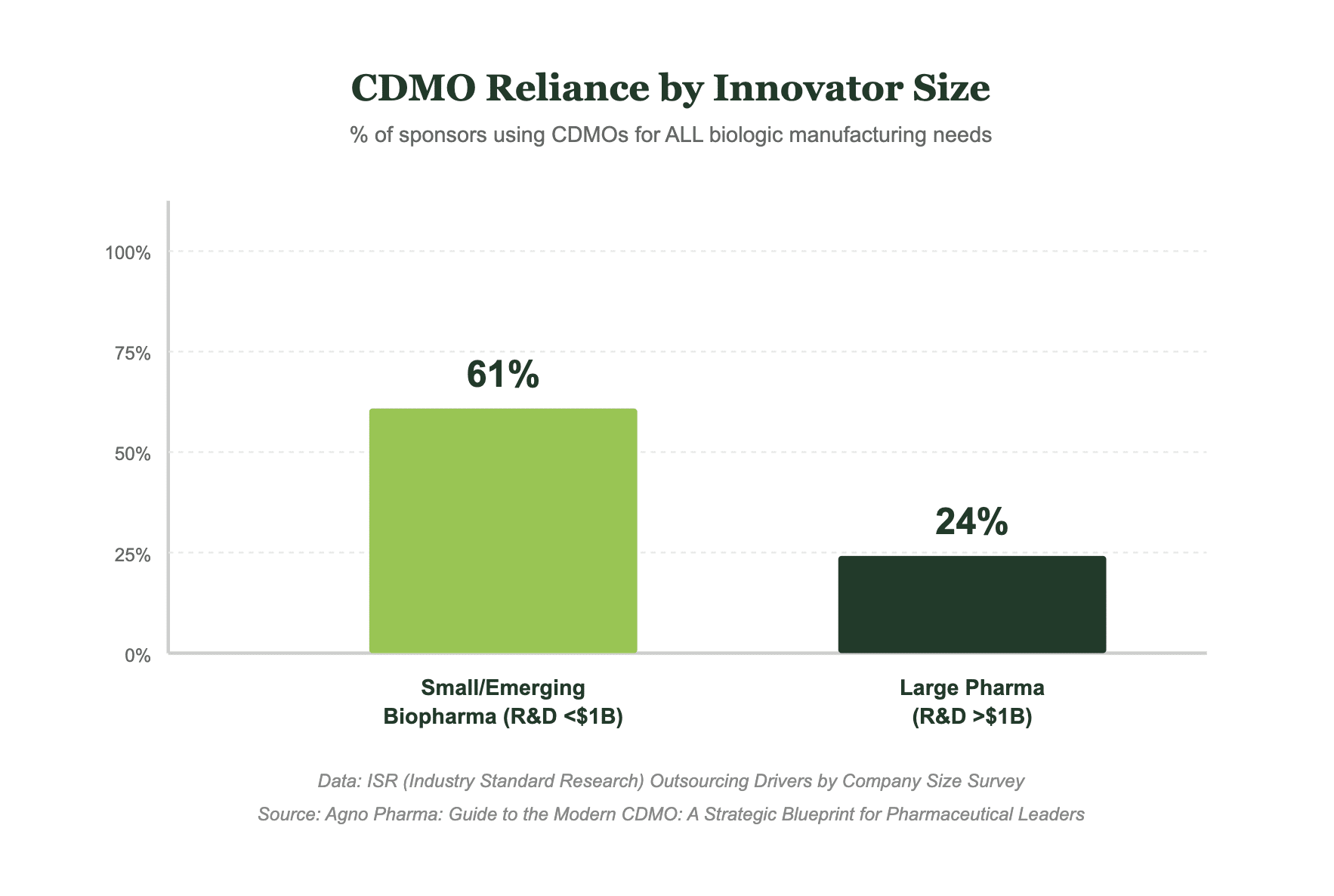
The strongest partnerships develop when organizational strategies align. A small biotech seeking a partner to grow from clinical trials through commercialization benefits from a CDMO seeking long-term relationships over short-term transactional revenue. Conversely, established pharmaceutical companies with diverse portfolios may prefer CDMOs offering a breadth of capabilities supporting multiple products simultaneously. Understanding and articulating what kind of partnership your organization seeks enables identification of CDMOs with compatible strategic orientations.
Conclusion: Transforming Outsourcing into Strategic Advantage
The Contract Development and Manufacturing Organization has evolved from an operational convenience into a strategic imperative for pharmaceutical companies of all sizes. With 73% of FDA-approved drugs outsourcing API manufacturing in 2025 — the highest rate on record, CDMO partnerships directly impact virtually every drug reaching patients today.
Success in this environment requires pharmaceutical leaders to approach CDMO engagement with strategic intentionality. This means clearly defining organizational needs and partnership expectations before approaching potential partners. It requires establishing rigorous but fair selection processes that identify partners whose capabilities, culture, and strategic orientation align with project requirements. It demands investing adequately in technology transfer planning and execution to mitigate the substantial risks inherent in moving processes between organizations.
Perhaps most importantly, success requires treating CDMOs as true partners rather than interchangeable vendors. Organizations that invest in building strong relationships, maintaining transparent communication, and creating governance structures enabling mutual success consistently outperform those taking purely transactional approaches. In an industry where drug development timelines, quality outcomes, and ultimately patient access depend on manufacturing excellence, choosing and nurturing the right CDMO relationships represents a critical leadership responsibility.
As therapeutic modalities grow more complex, regulatory expectations increase, and market pressures intensify, the importance of capable CDMO partners will only accelerate. Pharmaceutical leaders who master the principles and practices outlined in this guide position their organizations to thrive in this increasingly collaborative industry landscape, transforming outsourcing from a necessary compromise into a genuine competitive advantage.